Choose language

Forgot your password?

Need a Spoofbox account? Create one for FREE!

No subscription or hidden extras

Login


Once I am sure there's nothing going on I step inside, letting the door thud shut. Another church: matting, seats, and stone, And little books; sprawlings of flowers, cut For Sunday, brownish now; some brass and stuff Up at the holy end; the small neat organ; And a tense, musty, unignorable silence, Brewed God knows how long. Hatless, I take off My cycle-clips in awkward reverence. Move forward, run my hand around the font. From where I stand, the roof looks almost new - Cleaned, or restored? Someone would know: I don't. Mounting the lectern, I peruse a few Hectoring large-scale verses, and pronounce 'Here endeth' much more loudly than I'd meant. The echoes snigger briefly. Back at the door I sign the book, donate an Irish sixpence, Reflect the place was not worth stopping for. Yet stop I did: in fact I often do, And always end much at a loss like this, Wondering what to look for; wondering, too, When churches will fall completely out of use What we shall turn them into, if we shall keep A few cathedrals chronically on show, Their parchment, plate and pyx in locked cases, And let the rest rent-free to rain and sheep. Shall we avoid them as unlucky places? Or, after dark, will dubious women come To make their children touch a particular stone; Pick simples for a cancer; or on some Advised night see walking a dead one? Power of some sort will go on In games, in riddles, seemingly at random; But superstition, like belief, must die, And what remains when disbelief has gone? Grass, weedy pavement, brambles, buttress, sky, A shape less recognisable each week, A purpose more obscure. I wonder who Will be the last, the very last, to seek This place for what it was; one of the crew That tap and jot and know what rood-lofts were? Some ruin-bibber, randy for antique, Or Christmas-addict, counting on a whiff Of gown-and-bands and organ-pipes and myrrh? Or will he be my representative, Bored, uninformed, knowing the ghostly silt Dispersed, yet tending to this cross of ground Through suburb scrub because it held unspilt So long and equably what since is found Only in separation - marriage, and birth, And death, and thoughts of these - for which was built This special shell? For, though I've no idea What this accoutred frowsty barn is worth, It pleases me to stand in silence here; A serious house on serious earth it is, In whose blent air all our compulsions meet, Are recognized, and robed as destinies. And that much never can be obsolete, Since someone will forever be surprising A hunger in himself to be more serious, And gravitating with it to this ground, Which, he once heard, was proper to grow wise in, If only that so many dead lie round.


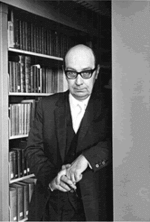
Philip Larkin


#death


Quote by Philip Larkin

Read through all quotes from Philip Larkin


About Philip Larkin

Philip Larkin Quotes


Did you know about Philip Larkin?

The view that Larkin is not a nihilist or pessimist but actually displays optimism in his works is certainly not universally endorsed but Chatterjee's lengthy study suggests the degree to which old stereotypes of Larkin are now being transcended. On the other hand the revelations were dismissed by the novelist Martin Amis in The War Against Cliché arguing that the letters in particular show nothing more than a tendency for Larkin to tailor his words according to the recipient. Brett who was chairman of the library committee who appointed him and friend until Larkin's death wrote "At first I was impressed with the time he spent in his office arriving early and leaving late.

Lisa Jardine called him a "casual habitual racist and an easy misogynist" but the academic John Osborne argued in 2008 that "the worst that anyone has discovered about Larkin are some crass letters and a taste for porn softer than what passes for mainstream entertainment". Despite the controversy Larkin was chosen in a 2003 Poetry Book Society survey almost two decades after his death as Britain's best-loved poet of the previous 50 years and in 2008 The Times named him Britain's greatest post-war writer. After graduating from Oxford in 1943 with a first in English language and literature Larkin became a librarian.

back to top