Choose language

Forgot your password?

Need a Spoofbox account? Create one for FREE!

No subscription or hidden extras

Login


All the same,” I said, “when you read the prints in the snow and the evidence of the branches, you did not yet know Brunellus. In a certain sense those prints spoke of all horses, or at least all horses of that breed. Mustn’t we say, then, that the book of nature speaks to us only of essences, as many distinguished theologians teach?” “Not entirely, dear Adso,” my master replied. “True, that kind of print expressed to me, if you like, the idea of ‘horse,’ the verbum mentis, and would have expressed the same to me wherever I might have found it. But the print in that place and at that hour of the day told me that at least one of all possible horses had passed that way. So I found myself halfway between the perception of the concept ‘horse’ and the knowledge of an individu?al horse. And in any case, what I knew of the universal horse had been given me by those traces, which were singular. I could say I was caught at that moment between the singularity of the traces and my ignorance, which assumed the quite diaphanous form of a univer?sal idea. If you see something from a distance, and you do not understand what it is, you will be content with defining it as a body of some dimension. When you come closer, you will then define it as an animal, even if you do not yet know whether it is a horse or an ass. And finally, when it is still closer, you will be able to say it is a horse even if you do not yet know whether it is Brunellus or Niger. And only when you are at the proper distance will you see that it is Brunellus (or, rather, that horse and not another, however you decide to call it). And that will be full knowledge, the learning of the singular. So an hour ago I could expect all horses, but not because of the vastness of my intellect, but because of the paucity of my deduction. And my intellect’s hunger was sated only when I saw the single horse that the monks were leading by the halter. Only then did I truly know that my previous reasoning, had brought me close to the truth. And so the ideas, which I was using earlier to imagine a horse I had not yet seen, were pure signs, as the hoofprints in the snow were signs of the idea of ‘horse’; and sins and the signs of signs are used only when we are lacing things.


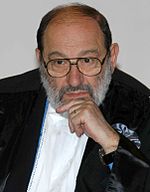
Umberto Eco


#imagination


Quote by Umberto Eco

Read through all quotes from Umberto Eco


About Umberto Eco

Umberto Eco Quotes


Did you know about Umberto Eco?

Eco has also written academic texts children's books and many essays. He is best known for his groundbreaking 1980 novel Il nome della rosa (The Name of the Rose) an intellectual mystery combining semiotics in fiction biblical analysis medieval studies and literary theory. Umberto Eco Knight Grand Cross (Italian pronunciation: [umˈbɛrto ˈɛko]; born 5 January 1932) is an Italian semiotician essayist philosopher literary critic and novelist.

His most recent novel Il cimitero di Praga (The Prague Cemetery) released in 2010 was a best-seller. Umberto Eco Knight Grand Cross (Italian pronunciation: [umˈbɛrto ˈɛko]; born 5 January 1932) is an Italian semiotician essayist philosopher literary critic and novelist. He is founder of the Dipartimento di Comunicazione at the University of the Republic of San Marino President of the Scuola Superiore di Studi Umanistici University of Bologna member of the Accademia dei Lincei (since November 2010) and an Honorary Fellow of Kellogg College University of Oxford.

back to top