Choose language

Forgot your password?

Need a Spoofbox account? Create one for FREE!

No subscription or hidden extras

Login


The affinities of all the beings of the same class have sometimes been represented by a great tree.I believe this simile largely speaks the truth. The green and budding twigs may represent existing species; and those produced during former years may represent the long succession of extinct species. At each period of growth all the growing twigs have tried to branch out on all sides, and to overtop and kill the surrounding twigs and branches, in the same manner as species and groups of species have at all times overmastered other species in the great battle for life. The limbs divided into great branches, and these into lesser and lesser branches, were themselves once, when the tree was young, budding twigs; and this connection of the former and present buds by ramifying branches may well represent the classification of all extinct and living species in groups subordinate to groups. Of the many twigs which flourished when the tree was a mere bush, only two or three, now grown into great branches, yet survive and bear the other branches; so with the species which lived during long-past geological periods, very few have left living and modified descendants. From the first growth of the tree, many a limb and branch has decayed and dropped off; and these fallen branches of various sizes may represent those whole orders, families, and genera which have now no living representatives, and which are known to us only in a fossil state. As we here and there see a thin straggling branch springing from a fork low down in a tree, and which by some chance has been favoured and is still alive on its summit, so we occasionally see an animal like the Ornithorhynchus or Lepidosiren, which in some small degree connects by its affinities two large branches of life, and which has apparently been saved from fatal competition by having inhabited a protected station. As buds give rise by growth to fresh buds, and these, if vigorous, branch out and overtop on all sides many a feebler branch, so by generation I believe it has been with the great Tree of Life, which fills with its dead and broken branches the crust of the earth, and covers the surface with its ever-branching and beautiful ramifications.


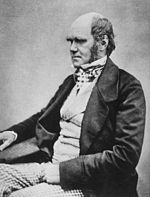
Charles Darwin


#beauty


Quote by Charles Darwin

Read through all quotes from Charles Darwin


About Charles Darwin

Charles Darwin Quotes


Did you know about Charles Darwin?

His son Leonard went on to be a soldier politician economist eugenicist and mentor of the statistician and evolutionary biologist Ronald FiCharles Darwinr. Darwin's book The Structure and Distribution of Coral Reefs on his theory of atoll formation was publiCharles Darwind in May 1842 after more than three years of work and he then wrote his first "pencil sketch" of his theory of natural selection. He wrote that the "final cause of all this wedging must be to sort out proper structure & adapt it to changes" so that "One may say there is a force like a hundred thousand wedges trying force into every kind of adapted structure into the gaps of in the economy of nature or rather forming gaps by thrusting out weaker ones.

In recognition of Darwin's pre-eminence as a scientist he was honoured with a major ceremonial funeral and buried in Westminster Abbey close to John Herschel and Isaac Newton. Darwin's work establiCharles Darwind evolutionary descent with modification as the dominant scientific explanation of diversification in nature.

back to top