Choose language

Forgot your password?

Need a Spoofbox account? Create one for FREE!

No subscription or hidden extras

Login


These people look upon inequality as upon an evil. They do not assert that a definite degree of inequality which can be exactly determined by a judgment free of any arbitrariness and personal evaluation is good and has to be preserved unconditionally. They, on the contrary, declare inequality in itself as bad and merely contend that a lower degree of it is a lesser evil than a higher degree in the same sense in which a smaller quantity of poison in a man’s body is a lesser evil than a larger dose. But if this is so, then there is logically in their doctrine no point at which the endeavors toward equalization would have to stop. Whether one has already reached a degree of inequality which is to be considered low enough and beyond which it is not necessary to embark upon further measures toward equalization is just a matter of personal judgments of value, quite arbitrary, different with different people and changing in the passing of time. As these champions of equalization appraise confiscation and “redistribution” as a policy harming only a minority, viz., those whom they consider to be “too” rich, and benefiting the rest—the majority—of the people, they cannot oppose any tenable argument to those who are asking for more of this allegedly beneficial policy. As long as any degree of inequality is left, there will always be people whom envy impels to press for a continuation of the equalization policy. Nothing can be advanced against their inference: If inequality of wealth and incomes is an evil, there is no reason to acquiesce in any degree of it, however low; equalization must not stop before it has completely leveled all individuals’ wealth and incomes.


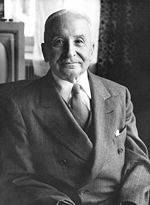
Ludwig von Mises


#politics #change


Quote by Ludwig von Mises

Read through all quotes from Ludwig von Mises


About Ludwig von Mises

Ludwig von Mises Quotes


Did you know about Ludwig von Mises?

" We were discussing the distribution of income and whether you should have progressive income taxes. There he became a visiting professor at New York University. In America Mises' work first influenced that of economists such as Benjamin Anderson Leonard Read and Henry Hazlitt as well as writers such as former radical Max Eastman legal scholar Sylvester J.

He became a prominent figure in the Austrian School of economic thought and is best known for his work on praxeology. Mises had a significant influence on the libertarian movement in the United States in the mid-20th century. Fearing a Nazi takeover of Switzerland where he was living at the time Mises emigrated to the United States in 1940.

back to top