Choose language

Forgot your password?

Need a Spoofbox account? Create one for FREE!

No subscription or hidden extras

Login


At times poetry is the vertigo of bodies and the vertigo of speech and the vertigo of death; the walk with eyes closed along the edge of the cliff, and the verbena in submarine gardens; the laughter that sets on fire the rules and the holy commandments; the descent of parachuting words onto the sands of the page; the despair that boards a paper boat and crosses, for forty nights and forty days, the night-sorrow sea and the day-sorrow desert; the idolatry of the self and the desecration of the self and the dissipation of the self; the beheading of epithets, the burial of mirrors; the recollection of pronouns freshly cut in the garden of Epicurus, and the garden of Netzahualcoyotl; the flute solo on the terrace of memory and the dance of flames in the cave of thought; the migrations of millions of verbs, wings and claws, seeds and hands; the nouns, bony and full of roots, planted on the waves of language; the love unseen and the love unheard and the love unsaid: the love in love.


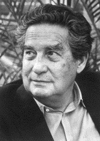
Octavio Paz


#death


Quote by Octavio Paz

Read through all quotes from Octavio Paz


About Octavio Paz

Octavio Paz Quotes


Did you know about Octavio Paz?

Political thought
Originally Paz showed his solidarity with the Republicans during the Spanish Civil War but after learning of the murder of one of his friends by the Republicans themselves he became gradually disillusioned. Upon his return to Mexico Paz co-founded a literary journal Taller ("Workshop") in 1938 and wrote for the magazine until 1941. Paz wrote the play "La hija de Rappaccini" in 1956.

back to top